Answer quick questions
Quick online consultation, no GP or pharmacy visits.
£139.99
New customers only Code MJSTARTMounjaro® is an MHRA-approved prescription injection that was initially developed for the treatment of Type 2 diabetes. During use, many patients experienced notable weight reduction, leading to its use as a medical option for weight management. The active ingredient in Mounjaro is tirzepatide.
Tirzepatide belongs to a group of medicines that act on hormone pathways involved in appetite and blood sugar regulation. It activates receptors for two hormones called GIP and GLP-1.
Tirzepatide works by imitating these specific hormones naturally released in the body that help regulate appetite and digestion. This can reduce hunger, increase feelings of fullness, and slow how quickly food is processed.
For best results, Mounjaro® should be used as part of a wider plan that includes a calorie-controlled diet and regular physical activity.
Mounjaro (tirzepatide) is a dual GIP and GLP-1 receptor agonist, meaning it activates receptors for two hormones involved in appetite regulation and blood glucose control.
GIP and GLP-1 receptors are found in areas of the brain involved in controlling appetite and food intake. By acting on these receptors, tirzepatide can increase feelings of fullness (satiety), reduce hunger and food cravings, and decrease the amount of food and calories consumed.
Tirzepatide also delays gastric emptying, meaning food leaves the stomach more slowly. Together, these effects can help reduce food intake and support weight loss and long-term weight management when Mounjaro is used alongside a reduced-calorie diet and increased physical activity.
| Active ingredient | Tirzepatide |
| How often it is taken | Once a week |
| How it is administered | Injection under the skin |
| Available strengths | 2.5 mg, 5mg, 7.5mg, 10mg, 12.5mg and 15mg |
| Starting dose | 2.5mg once weekly |
| Maximum dose | 15mg once weekly |
| Prescription required |
Yes |
| How treatment is approved | Following a clinical assessment |
Mounjaro may be prescribed for weight management in adults who meet certain clinical criteria.
You may be considered for treatment if you have the following:
BMI of 30 kg/m² or above.
BMI of 27 kg/m² or above but below 30 kg/m², together with at least one weight-related health condition.
Examples of weight-related health conditions include high blood pressure, abnormal blood lipid levels, obstructive sleep apnoea, cardiovascular disease, prediabetes or type 2 diabetes.
Mounjaro is prescribed alongside a reduced-calorie diet and increased physical activity. Meeting the BMI criteria does not automatically mean that treatment is suitable. A prescriber will review your health information, medical history and current medicines before deciding whether Mounjaro is appropriate for you.
Mounjaro® (tirzepatide) may not be suitable for everyone. During your consultation, it is important to provide complete and accurate information about your health, medical history and any medicines you are taking so that a prescriber can assess whether treatment is appropriate for you.
Your prescriber may need to take particular care if you:
have previously had pancreatitis;
have severe digestive problems or delayed stomach emptying, including severe gastroparesis;
have certain diabetic eye conditions, such as diabetic retinopathy or macular oedema; or
take insulin or a sulphonylurea for diabetes, as using these medicines with Mounjaro can increase the risk of hypoglycaemia (low blood sugar) and their doses may need to be adjusted.
Mounjaro should not be used if you are allergic to tirzepatide or any of the other ingredients in the medicine. It should also not be used during pregnancy. If you are pregnant, think you may be pregnant or are planning a pregnancy, tell your prescriber before starting treatment.
Your individual medical history and current medicines will be reviewed as part of the prescribing assessment before Mounjaro is supplied.
The most common side effects of Mounjaro® (tirzepatide) affect the digestive system and include nausea, diarrhoea, vomiting, constipation and abdominal pain. These side effects are usually mild to moderate and are often more noticeable when starting treatment or increasing the dose, before decreasing over time.
Other common side effects can include indigestion, bloating, burping, flatulence, acid reflux or heartburn, fatigue, hair loss and injection-site reactions such as redness or itching.
If you experience side effects that are severe, persistent or concerning, speak to your prescriber, pharmacist or another healthcare professional.
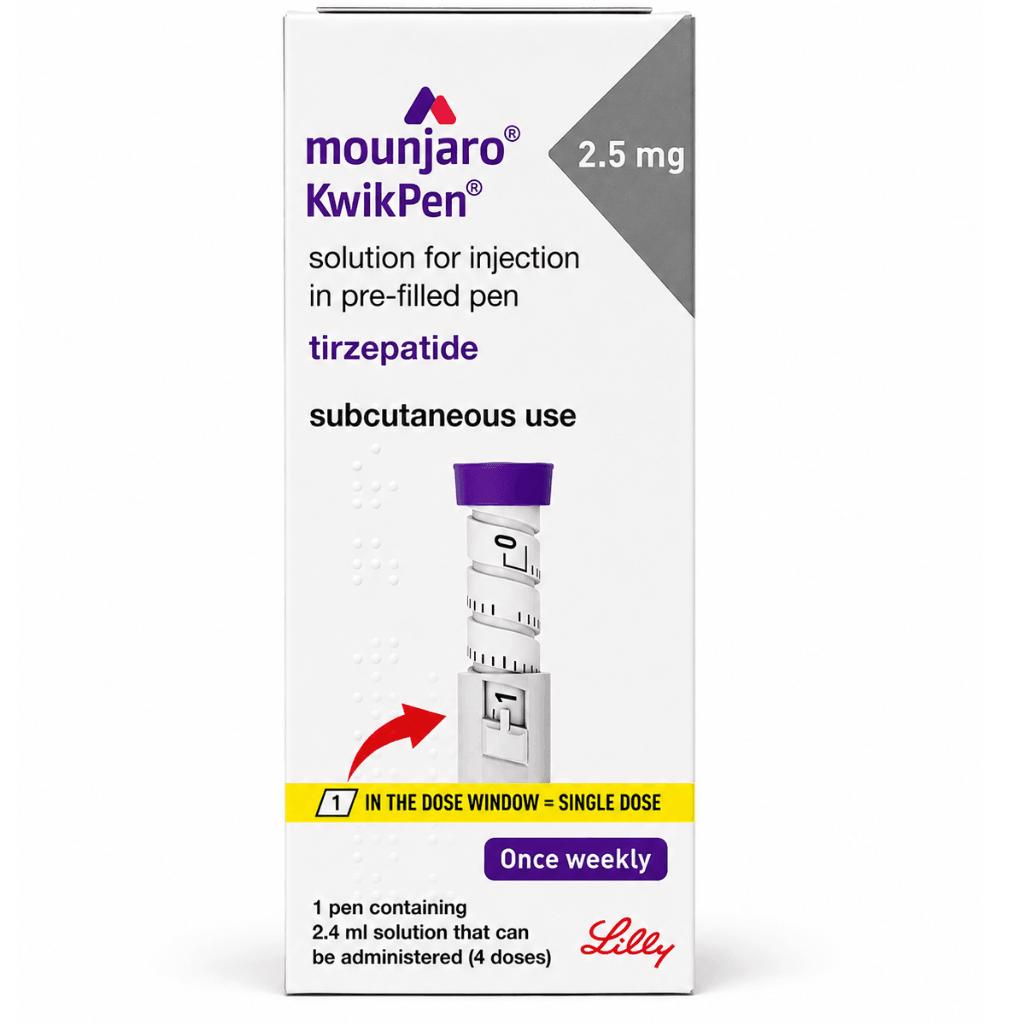
Mounjaro® is administered once weekly using a pre-filled injection pen. Your healthcare provider will explain the injection process during your consultation.
You can take your dose at any time of day, with or without food. You should follow the instructions provided with your specific Mounjaro KwikPen and the advice given by your healthcare professional.
Mounjaro® can be injected into:
The abdomen
The thigh
The back of the upper arm (with assistance if needed)

Injection sites should be rotated with each dose. If you also use insulin, Mounjaro should be injected at a different injection site.
Always read the instructions supplied with your Mounjaro KwikPen before using it. If you are unsure how to use your pen or inject your dose, speak to your prescriber or pharmacist.
Mounjaro® is available in multiple strengths and follows a gradual dose-increase schedule to help minimise side effects.
Treatment usually starts at 2.5mg once weekly.
This starting dose is typically used for 4 weeks to allow adjustment.
Dose increases may be recommended by your doctor based on tolerance and response.
Mounjaro Treatment schedule:

The dose does not need to be increased to the maximum strength. Your prescriber will determine the appropriate dose based on your individual response and how well you tolerate treatment. You should only change your Mounjaro dose when advised to do so by your prescriber. The maximum recommended dose for adults is 15mg once weekly.
If you miss a dose of Mounjaro:
If it has been 4 days or less, take the missed dose as soon as possible.
If more than 4 days have passed, skip the missed dose and take your next dose on your usual scheduled day.
After this, continue with your normal once-weekly schedule.
Do not take two doses to make up for a missed dose.
Before first use, Mounjaro® KwikPen should be stored in a refrigerator at 2°C to 8°C. Do not freeze Mounjaro. If the pen has been frozen, do not use it.
After first use, the Mounjaro KwikPen can be stored unrefrigerated at a temperature not above 30°C for up to 30 days. After 30 days, the pen must be discarded.
Keep Mounjaro out of the sight and reach of children. Do not use the pen if it is damaged or if the medicine appears cloudy, discoloured or contains visible particles.
If you are unsure whether your Mounjaro has been stored within the recommended temperature range, speak to a pharmacist or prescriber before using it.
After each Mounjaro® injection, carefully follow the KwikPen instructions for removing the needle. Replace the outer needle shield, unscrew the capped needle and place it immediately into an appropriate sharps bin. Never dispose of loose used needles in household waste or recycling.
If you are starting injectable weight-loss treatment with Genmeds for the first time, we provide a sharps bin as part of your onboarding. If you are already using weight-loss injections and need a replacement or additional sharps bin, you can purchase one through Genmeds.
Once you have used all four prescribed doses, the Mounjaro KwikPen should also be discarded, even if a small amount of medicine remains. Do not try to use any medicine left in the pen. Follow the disposal advice provided by your pharmacist or healthcare professional, as medicines should not be disposed of through household waste or wastewater.
When your sharps bin reaches its marked fill line, close it securely and follow your local arrangements for collection or disposal. These arrangements can vary by area, so contact your local council, pharmacist or healthcare provider if you are unsure. Do not place a filled sharps bin in your household waste or recycling.
Start with a short online consultation, then our clinical team reviews your answers before any treatment is approved. If suitable, your order is prepared securely and sent in discreet packaging.
Quick online consultation, no GP or pharmacy visits.

Select from recommended UK-licensed medications.

Delivered to your door in discreet packaging.