
This article is for adults taking omeprazole or lansoprazole for heartburn. Follow your prescription and the leaflet for your medicine; do not change the dose yourself.
It can be frustrating to deal with heartburn at night, right when you are attempting to settle down and sleep after a busy day.
Even if your medication effectively controls your heartburn during the daytime, bedtime symptoms can often intensify despite taking your prescribed dose of Lansoprazole or Omeprazole.
So, what can cause night-time heartburn to persist?
What is heartburn?
When acid from your stomach goes up towards your throat, it can cause a burning sensation in your chest and a sour taste in your mouth. This is known as ‘heartburn’. If heartburn keeps happening, it may be a condition called gastro-oesophageal reflux disease or GORD for short.
What causes heartburn?
Heartburn is caused by several factors, including but not limited to:
- Eating certain foods like fatty or spicy food
- Drinking certain drinks like coffee or alcohol
- Smoking, which can relax the muscle between your oesophagus and stomach
- Stressful events
- Lying down after a hefty meal
- Hormonal changes and physical pressure of the baby on the stomach during pregnancy
- Increased abdominal pressure if overweight
- Taking some medications like aspirin, ibuprofen or naproxen
What can you do to improve your symptoms?
To help stop acid travelling from your stomach to throat, you can make a few lifestyle adjustments that might help you cope with acid reflux:
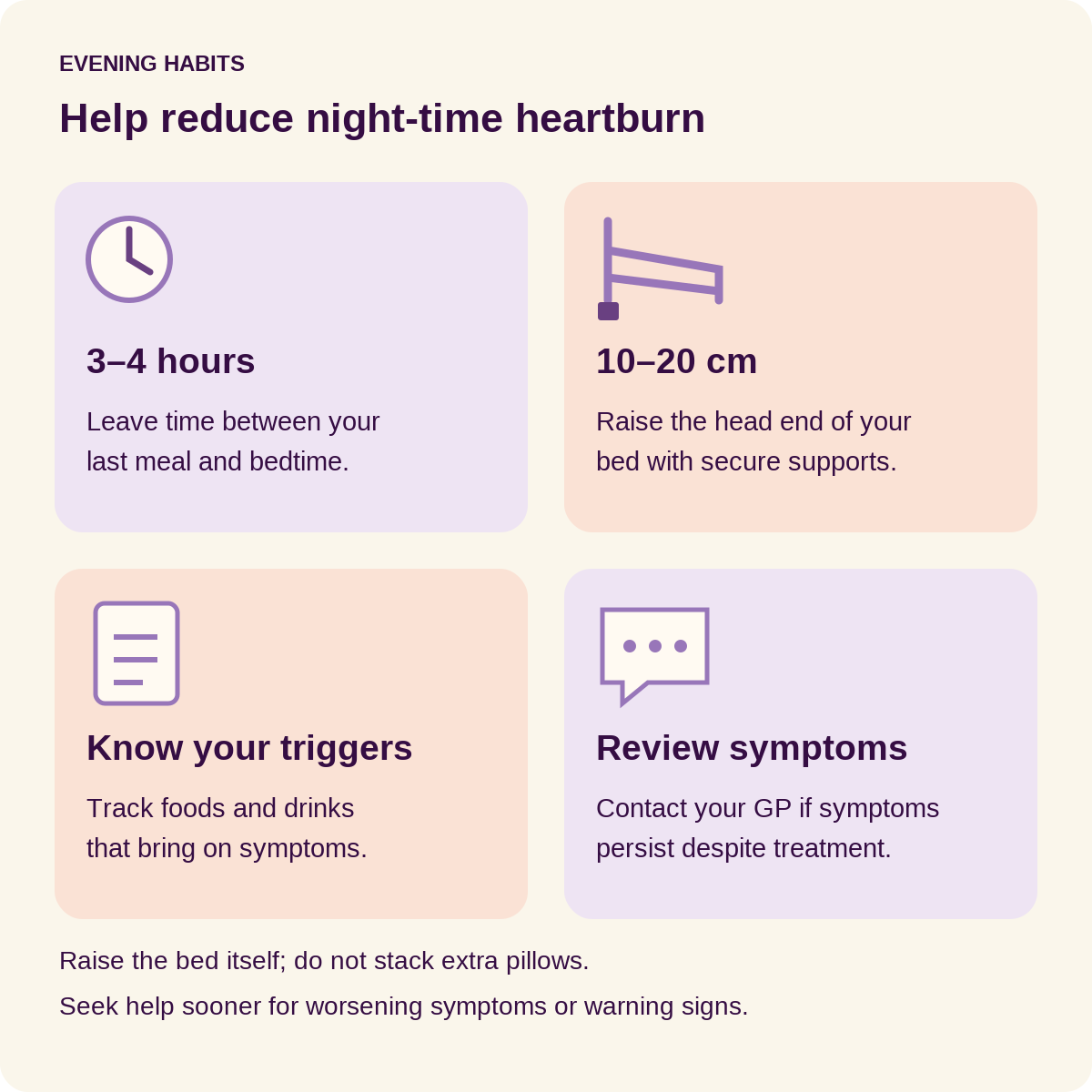
- If you notice any kind of food or drink causing you heartburn, avoid it. You can track causative factors using a diary.
- Consult healthcare professionals for support and guidance on smoking cessation.
- Leave at least 3-4 hours between your last meal and bedtime.
- Raise the head end of your bed by 10–20 cm using secure, sturdy supports so your chest and head are above your waist; avoid relying on additional pillows, which can place extra pressure on your stomach.
- Seek advice regarding healthy weight management if excess weight is impacting your overall health.
- Do not stop taking your medications without consulting your doctor. Your doctor might be able to prescribe some medications for acid reflux such as omeprazole or lansoprazole.
How to take your omeprazole or lansoprazole
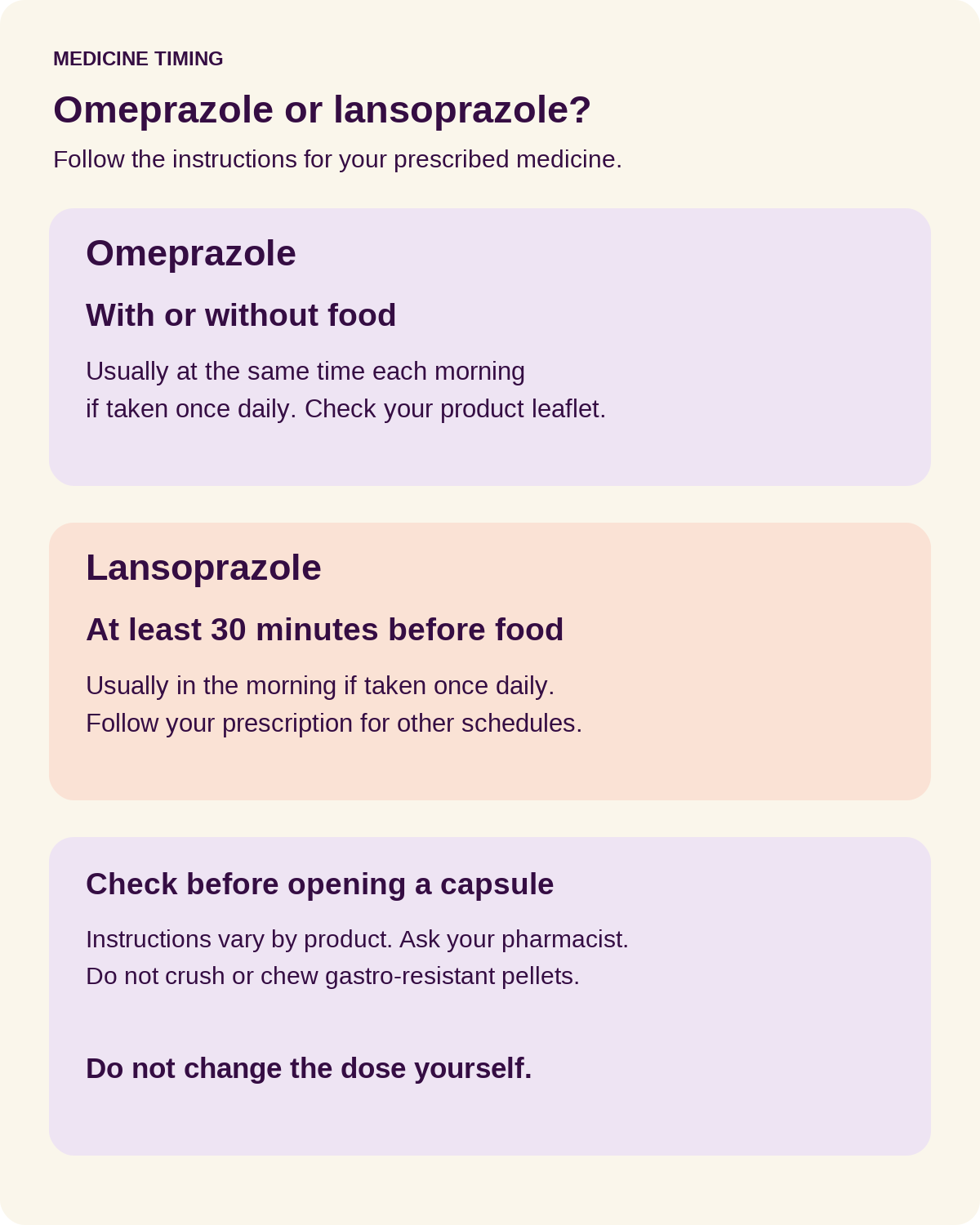
Experiencing persistent heartburn even while using prescribed treatment can sometimes be linked to dose timing. Taking lansoprazole after eating can reduce how well it works; omeprazole can be taken with or without food. Take your medicine at the times advised by your prescriber or the leaflet.
Below is a guide detailing the proper administration guidelines for both medications.
Omeprazole is available as capsules, tablets, liquid, and dispersible forms. Capsules should usually be swallowed whole with water at the same time each morning if taken once daily. Omeprazole can be taken with or without food; follow the instructions for your particular product. Gastro-resistant capsules and their pellets must not be chewed or crushed.
If you have trouble swallowing capsules, ask your pharmacist whether your particular capsule can be opened. For products that allow this, follow the leaflet for mixing the contents with still water, an appropriate fruit juice or apple sauce, and for how soon to take the mixture. Do not chew or crush the pellets, and rinse the container as directed to take the full dose.
Lansoprazole comes as capsules and orodispersible tablets that melt in your mouth. Capsules should be swallowed whole with water or juice, usually in the morning at least 30 minutes before eating. Orodispersible tablets are placed on the tongue and allowed to melt; follow your leaflet.
For those who struggle to swallow capsules whole, some lansoprazole capsules can be opened, following the instructions in your leaflet, and the contents mixed into a small amount of water or fruit juice, or sprinkled over soft foods like apple purée or yoghurt. Neither the capsules nor the granules inside should be chewed or crushed.
| Omeprazole | Lansoprazole | |
|---|---|---|
| Available forms | Capsules; tablets; oral liquid; some dispersible tablets | Capsules; orodispersible tablets |
| Administration | With or without food. Usually at the same time each morning if once daily; follow your leaflet. Swallow gastro-resistant capsules/tablets with water; do not crush or chew. | At least 30 minutes before food. Swallow capsules with water or juice. Let orodispersible tablets melt on the tongue. Do not crush or chew the protected granules. |
| Difficulty swallowing capsules | Ask your pharmacist whether your capsule can be opened. Follow its leaflet for the mixing liquid, timing and rinsing. Do not chew the pellets. | Check the leaflet before opening a capsule. If permitted, mix the granules as directed and swallow without chewing. |
When to seek help?
While occasional heartburn is common, you should seek medical attention if you experience:
- Difficulty swallowing: ask for an urgent GP appointment or contact NHS 111.
- Vomiting blood: always get medical help. Call 999 or go to A&E if you also feel unwell, faint or dizzy, have tummy pain or black stools. If the vomiting has stopped and you have no other symptoms, ask for an urgent GP appointment or call NHS 111.
- Black, tarry stools: ask for an urgent GP appointment or contact NHS 111; if you are also vomiting blood or feel very unwell, seek emergency help.
- Loss of appetite or unexplained weight loss: arrange a GP assessment.
- Sudden chest pain or discomfort that does not go away, pain spreading to an arm, neck, jaw, stomach or back, or chest pain with sweating, sickness, light-headedness or breathlessness: call 999. A heart attack can feel like indigestion. Chest pain that comes and goes, including with exercise, also needs medical assessment.
- Persistent symptoms despite taking your medication as prescribed: contact your GP for review, especially if symptoms continue after 2–4 weeks. Seek advice sooner if symptoms worsen or you have any warning signs above. If you bought omeprazole without a prescription, do not take it for longer than 2 weeks without medical advice.